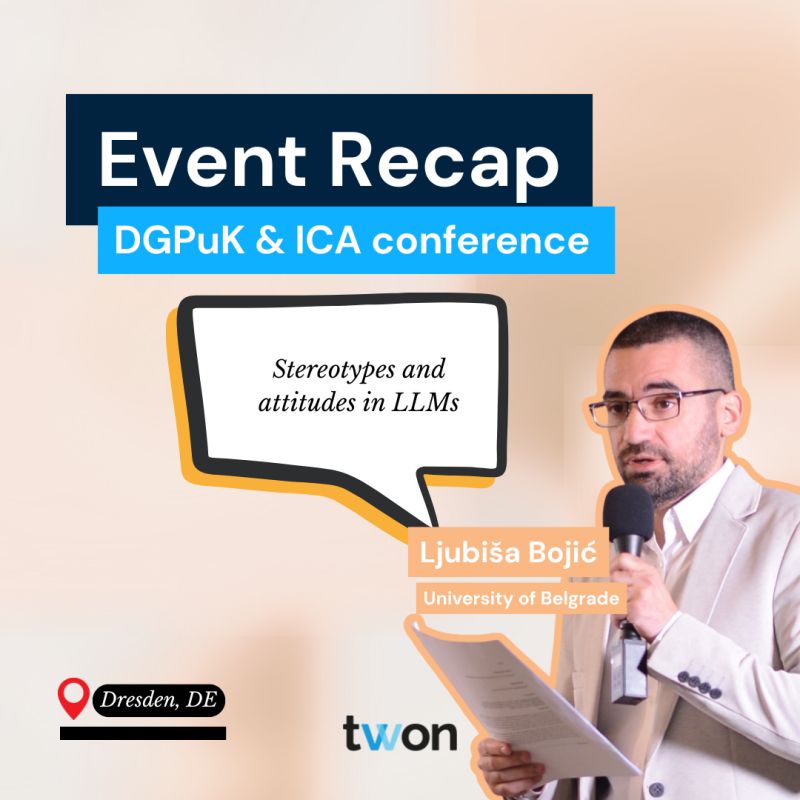
TWON researcher Ljubisa Bojic participated in the DGPuK & ICA conference on Digital Communication and Human-Machine Communication, held from 15 to 17 September at Technische Universität Dresden. Under the theme “Machines as (new) actors in digital communication: challenges and opportunities for science and society,” the conference explored how AI systems shape communication, society and knowledge.
As part of the conference programme, Ljubisa Bojic presented insights from his research in the TWON project on social stereotypes and attitudes in large language models. His presentation examined how LLMs evaluate different social groups, including women, men, refugees, asylum seekers and economic migrants, along the stereotype dimensions of warmth and competence.
The findings indicate significant differences in how LLMs assess these groups. Statistical analysis confirms that these differences are highly significant, with particularly large variations in competence scores for refugees and economic migrants. The presentation also highlighted interaction effects between model and language, showing that both the choice of LLM and the language used can shape stereotype-related outcomes.
By addressing social stereotypes in LLMs, the presentation contributes to ongoing discussions on the societal implications of AI systems and the challenges of ensuring fairness, accountability and transparency in digital communication.