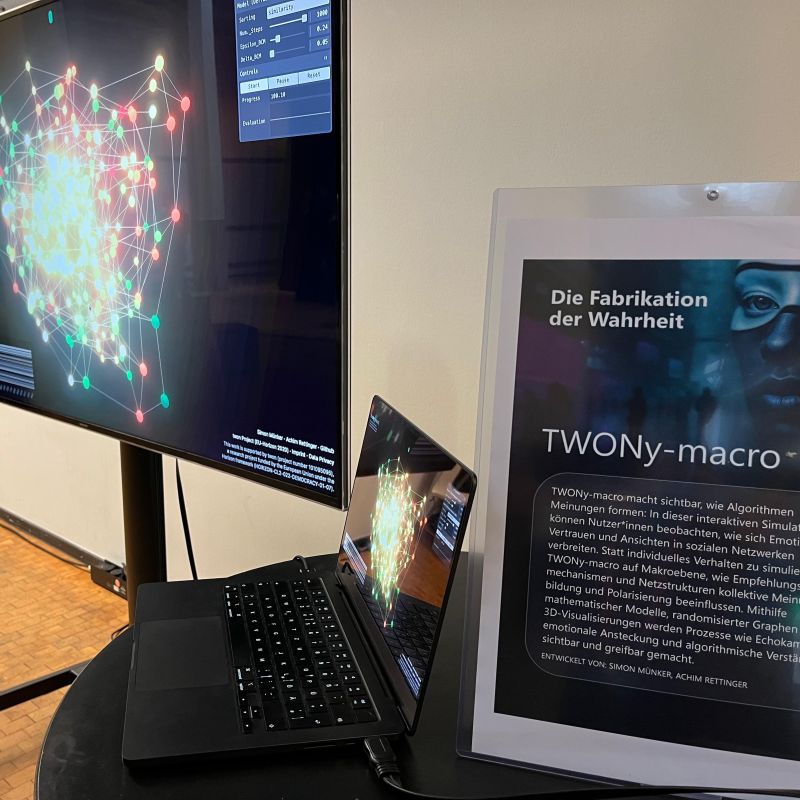
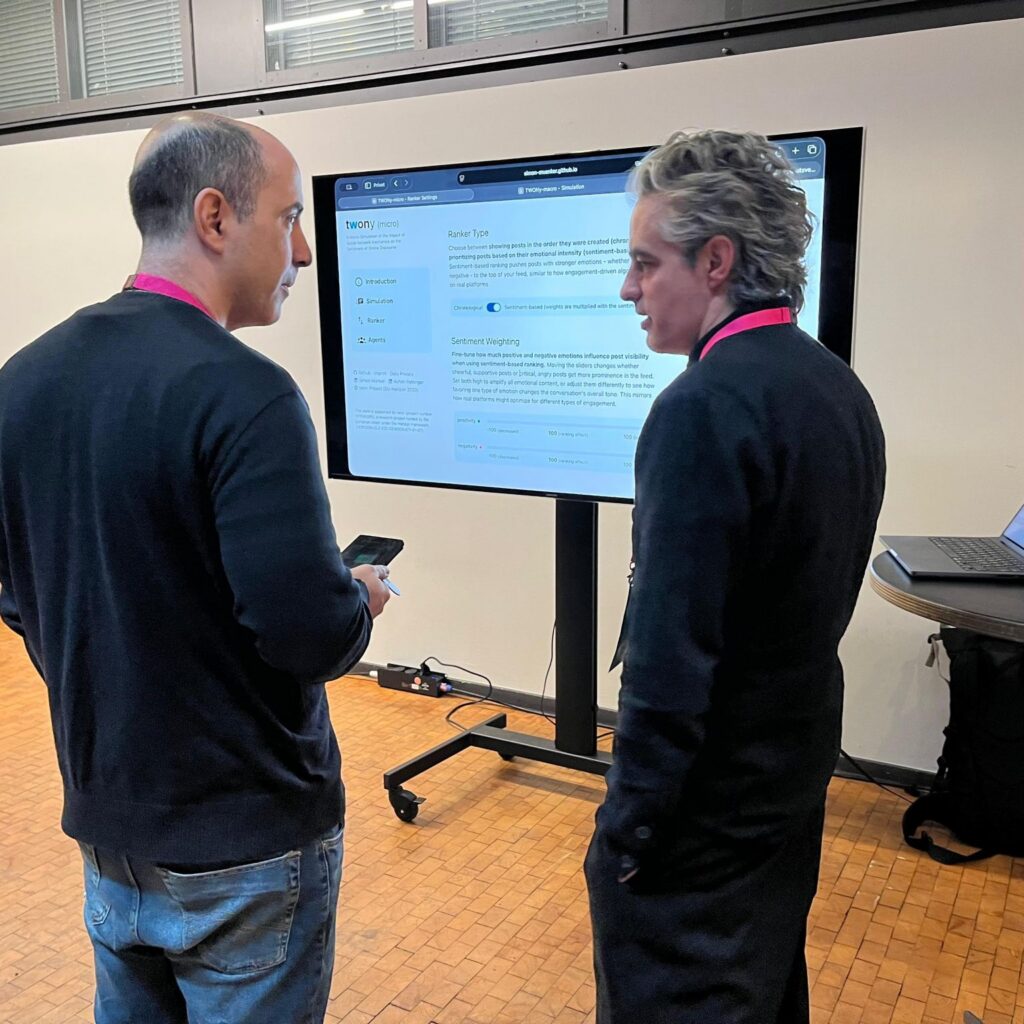
On 24 October, TWON researchers Achim Rettinger and Simon Münker joined the symposium “The Fabrication of Truth” at ZKM Karlsruhe, which focused on fake news, deepfakes, and the post-factual society. The event offered an opportunity to engage with visitors and present macroTWONy, a TWON demonstrator that explores how network topology and algorithmic sorting strategies influence collective opinion formation and emotional polarization.
By connecting current debates on misinformation and digital public spheres with interactive research tools, the symposium highlighted the importance of understanding how online environments shape social dynamics and public discourse. Visitors were invited to explore macroTWONy and gain insights into the mechanisms that contribute to opinion formation and polarization in online social networks.
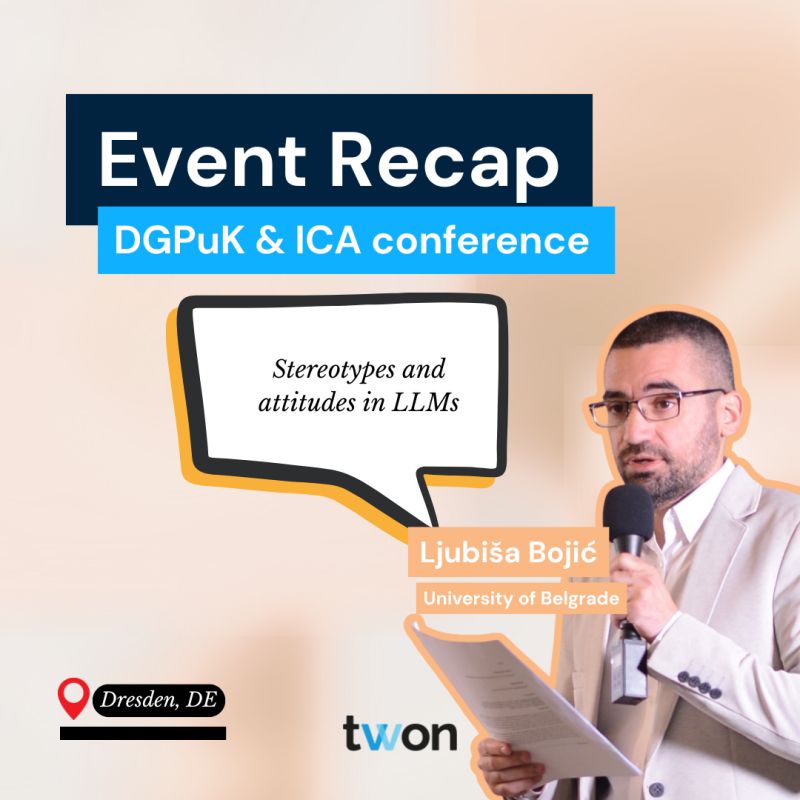
TWON researcher Ljubisa Bojic participated in the DGPuK & ICA conference on Digital Communication and Human-Machine Communication, held from 15 to 17 September at Technische Universität Dresden. Under the theme “Machines as (new) actors in digital communication: challenges and opportunities for science and society,” the conference explored how AI systems shape communication, society and knowledge.
As part of the conference programme, Ljubisa Bojic presented insights from his research in the TWON project on social stereotypes and attitudes in large language models. His presentation examined how LLMs evaluate different social groups, including women, men, refugees, asylum seekers and economic migrants, along the stereotype dimensions of warmth and competence.
The findings indicate significant differences in how LLMs assess these groups. Statistical analysis confirms that these differences are highly significant, with particularly large variations in competence scores for refugees and economic migrants. The presentation also highlighted interaction effects between model and language, showing that both the choice of LLM and the language used can shape stereotype-related outcomes.
By addressing social stereotypes in LLMs, the presentation contributes to ongoing discussions on the societal implications of AI systems and the challenges of ensuring fairness, accountability and transparency in digital communication.
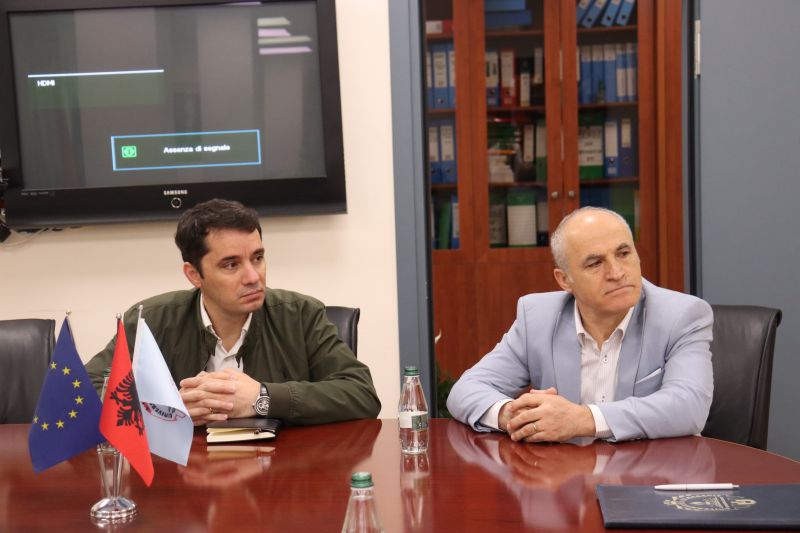
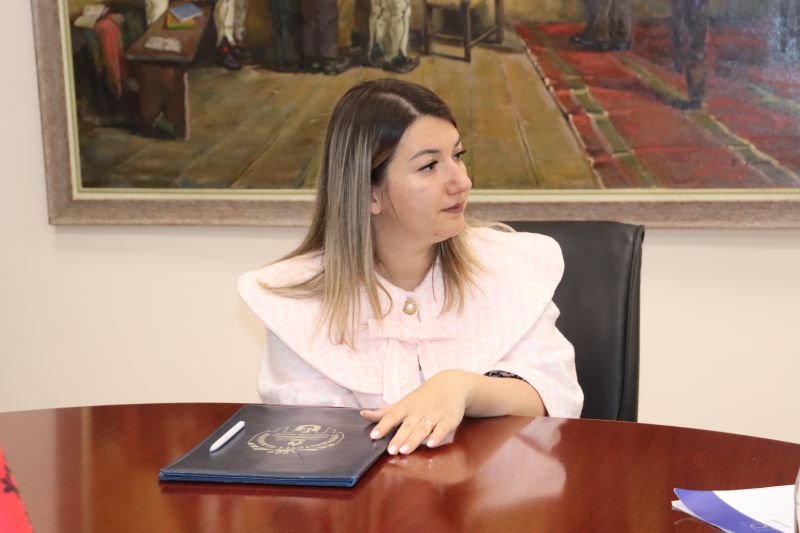
TWON researcher Sjoerd Stolwijk presented work from the Twin of Online Social Networks project during a visit to Tirana, Albania. The visit took place in the context of academic cooperation between Vrije Universiteit Amsterdam and the University of Elbasan “Aleksandër Xhuvani.”
The exchange highlighted the importance of international research collaboration and knowledge diplomacy. Research and education can serve as bridges between cultures and institutions, fostering dialogue, cooperation and mutual understanding across Europe.
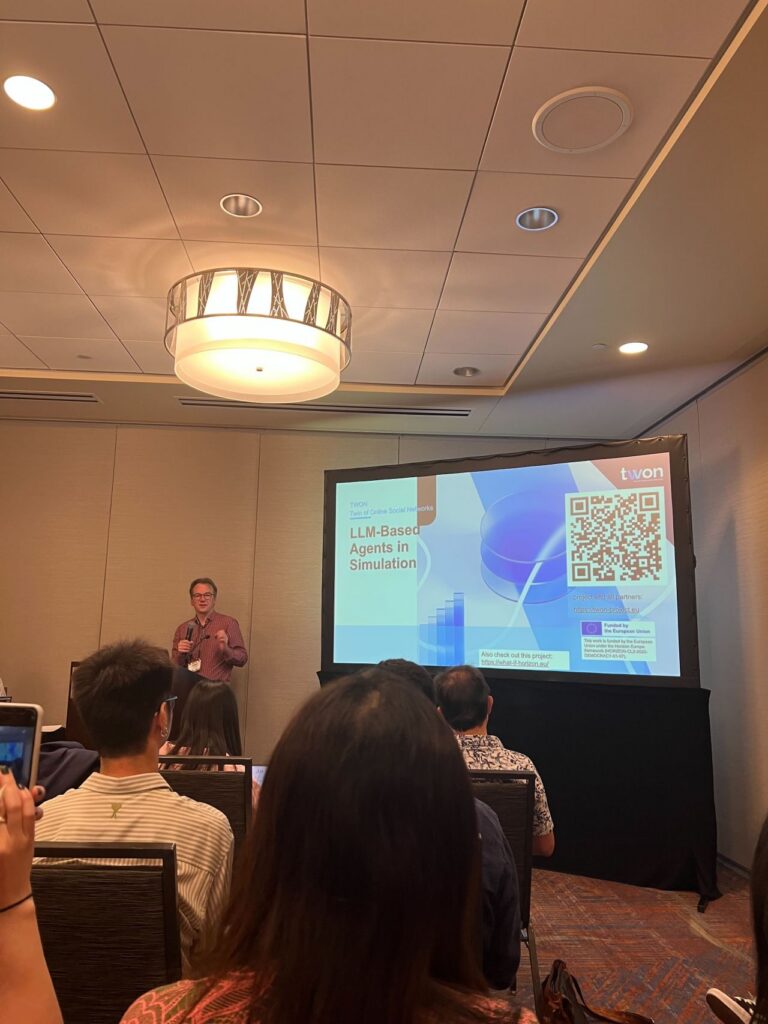
TWON researcher Damian Trilling represented the Twin of Online Social Networks project at the International Communication Association (ICA) conference in Denver, Colorado. His talk focused on the use of LLM-based agents in simulations and contributed to the wider panel discussion on Generative AI for Computational Communication Research.
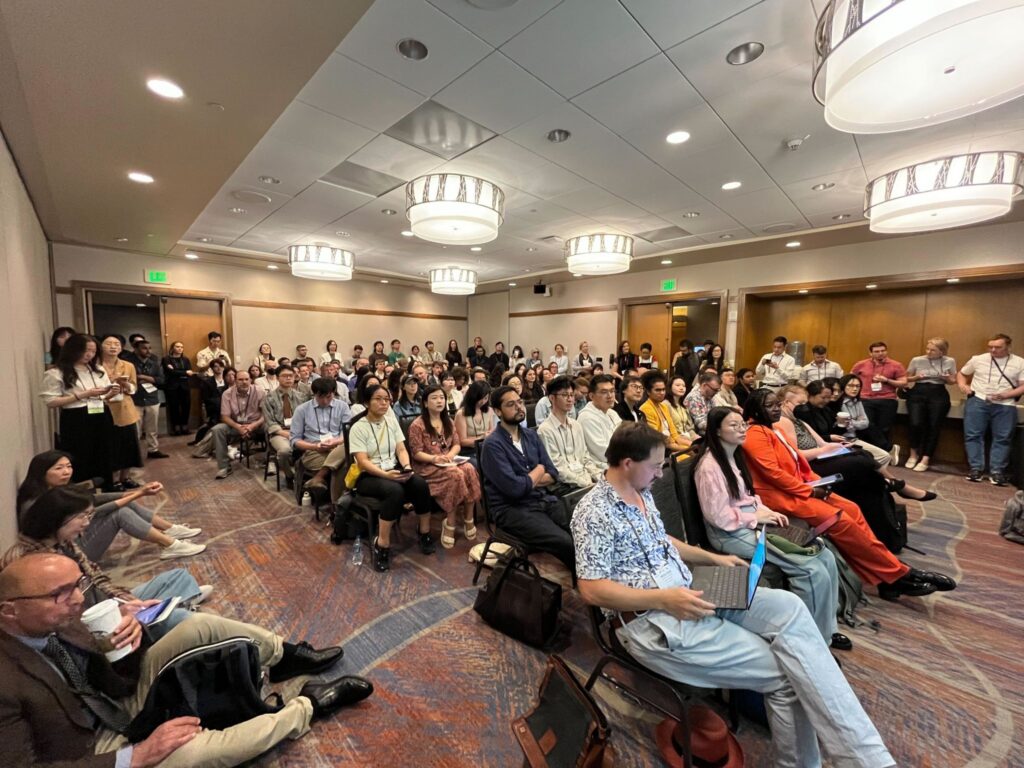
The session attracted strong interest, with around 100 attendees joining the talk and discussion. Damian Trilling’s contribution highlighted how generative AI and agent-based approaches can open new pathways for computational communication research, while also raising important methodological questions for the field.
TWON researcher Dr. Jonas Fegert participated in the Digital Salon hosted by the Alexander von Humboldt Institute for Internet and Society. The discussion focused on AI regulation and the democratic challenges that arise when technological developments move faster than legislative processes.
Together with Dr. Annette Zimmermann from the University of Wisconsin-Madison, Jonas Fegert discussed how different political systems respond to the rapid development of artificial intelligence. The conversation compared regulatory approaches in the European Union and the United States, including the EU’s risk-based approach under the AI Act and the role of the Digital Services Act in increasing platform accountability.
The discussion also addressed the more fragmented regulatory landscape in the United States, where voluntary commitments by technology companies continue to play an important role. By examining these different approaches, the event reflected on how democracies can shape AI development in ways that balance innovation, public interest and fundamental rights.
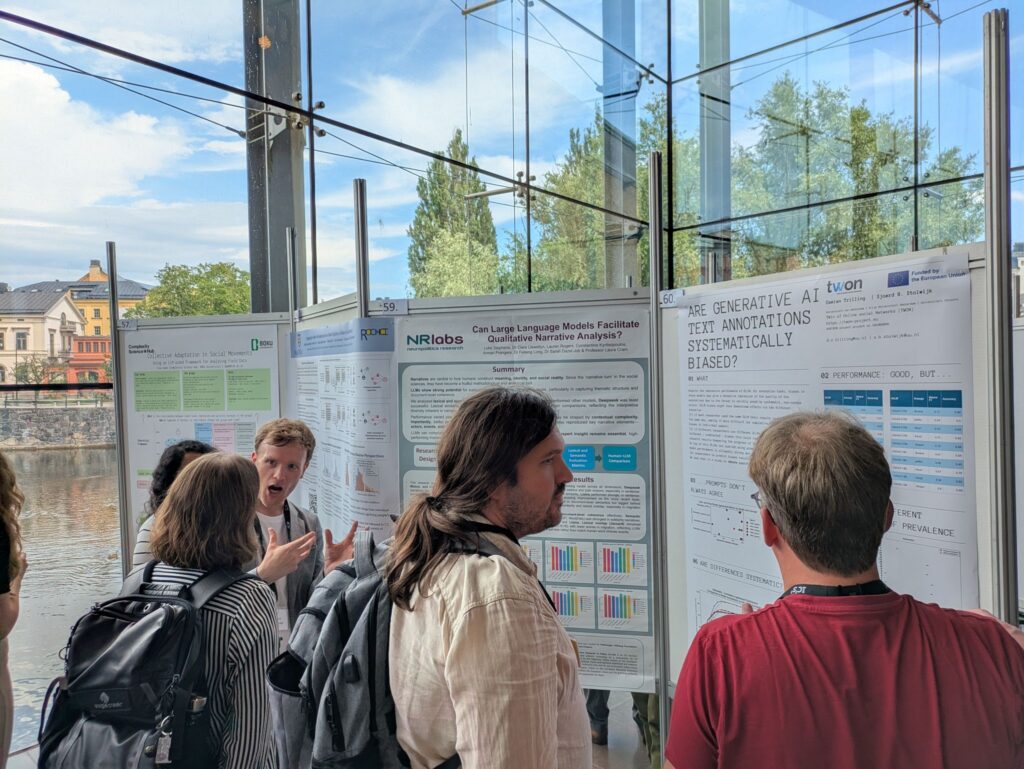
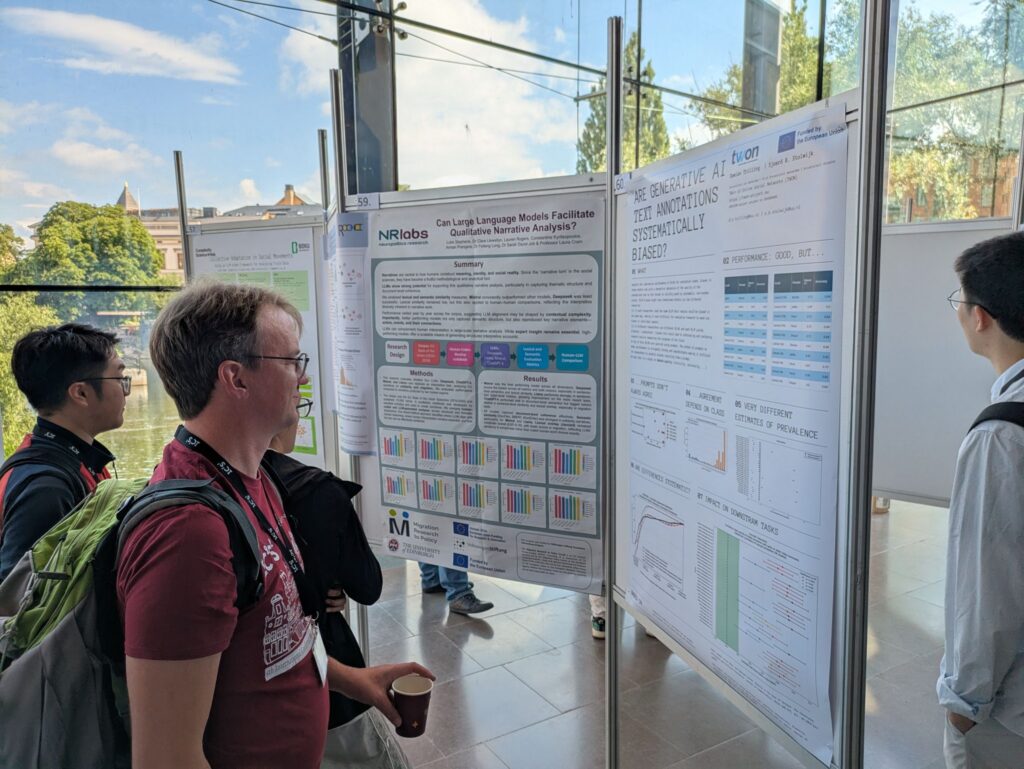
TWON researchers Damian Trilling and Sjoerd Stolwijk presented their research on bias in generative AI text annotations at IC2S2 – the International Conference on Computational Social Science in Norrköping, Sweden. Their poster, titled “Are Generative AI text annotations systematically biased?”, addressed the question of whether generative large language models produce biased annotations when processing texts that include identity terms.
Their findings show that generative large language models can perform well in text annotation tasks, but that their annotations are not neutral across all contexts. The models treated identity terms differently, and annotation outcomes were influenced by the specific identity group mentioned in the text. The study also found systematic and predictable identity-based bias, although the patterns differed depending on the model used.
These results raise important methodological concerns for researchers using generative AI tools for text annotation. If different researchers rely on different models, undetected model-specific biases may lead to contrasting results. At the same time, if many researchers use the same model, their findings may be biased in similar ways. The poster therefore highlights the need for careful evaluation, transparency and critical reflection when applying generative AI in computational social science.
TWON colleagues reconnected with Denisa Reshef Kera, keynote speaker at the TWON SemGenAge Workshop in Portorož, during the Conference on Philosophy of Computing and AI at the University of Twente. The conference was hosted by the International Association for Computing and Philosophy (IACAP) and AISB.
The meeting offered an opportunity to continue conversations initiated at SemGenAge and to further exchange perspectives on philosophy, computing and artificial intelligence. Such follow-up exchanges highlight the importance of international academic networks and interdisciplinary dialogue in addressing the societal and conceptual implications of AI.
The new podcast episode by Dialogue Perspectives explores democracy in the digital age. In this episode, hosts Neta-Paulina Wagner, Whitney Nosakhare and Henri Vogel are joined by TWON researcher Dr. Jonas Fegert to discuss how social networks shape societal discourse, democratic participation and public trust.
The conversation addresses both the connective potential of digital platforms and the risks posed by echo chambers, algorithmic content curation and disinformation. It also reflects on the responsibilities of big tech platforms, governments and individuals in fostering a more accountable and resilient digital democracy.